
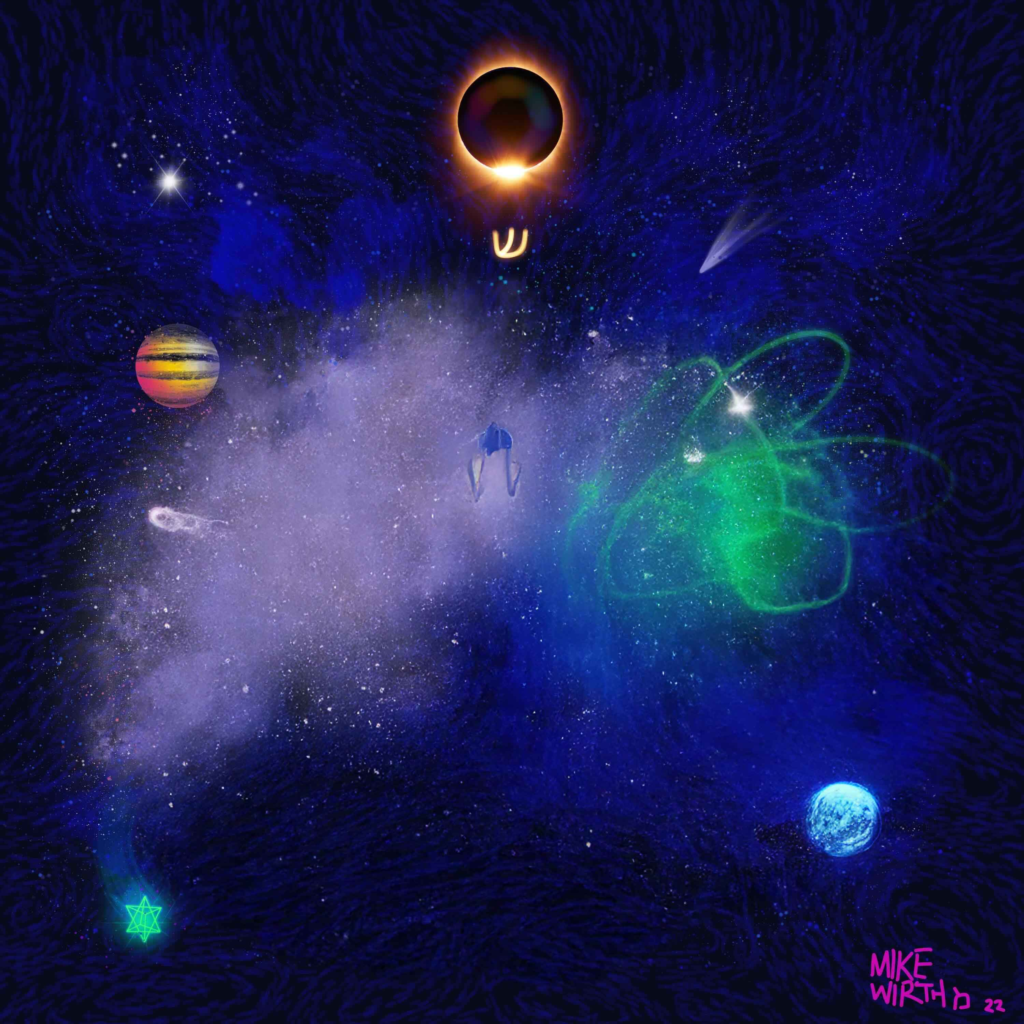
Jewish futurism is the contemporary naming of a legacy of futuristic thinkers, thoughts, and objects across Jewish time and space.
Some have called it a standalone discipline of scholarship or a creative genre, but it’s actually a thinking tradition (mesorah,מסורה) already present in Jewish thought. One that takes into account the impact of one’s actions on future generations, using Jewish memory, text, and ritual as material for thinking AND building practical Jewish futures.
I’m Mike Wirth, and I’ve spent over a decade making work that walks in the legacy of this mindset, first creating Jewish-themed futuristic art without a name for it in 2015, and since 2019, under the specific banner of Jewish futurism. This podcast, The Jewish futurism Lab: Torah, Tech, Tomorrow, is where I explore that mindset out loud, in conversation with Jewish artists, thinkers, and educators who are doing exciting things.
A Legacy, Not an Invention
This way of thinking spans centuries, from messianic prophecy through Kabbalistic cosmology, the legend of the Golem, and 20th-century Jewish artists and writers who imagined new futures through their work. I see the podcast, and my own creative practice, as a voice continuing that legacy of thousands of years rather than starting something new.
My Own Path Into It
I began exhibiting and publishing Jewish-themed art and design work with futuristic ideas in 2015, but didn’t have the language to call it Jewish futurism until 2019 during an exhibit Constellations at the Mint Museum in Charlotte. My approach borrows the visual energy of 20th-century Italian Futurism, a movement I’ve taught graphic design history for 21 years, while rejecting the fascist politics of its founder, F.T. Marinetti. That’s why I write “futurism” in lowercase.
Design, not just theory, is central to how I work. I lead hands-on workshops, including Shabbat UX, where participants prototype Jewish rituals using design principles rather than just discussing ideas.
Go Deeper
For the full history, methodology, and project gallery behind this work, visit my main Jewish futurism hub on my site:
Frequently Asked Questions
Jewish futurism is the contemporary naming of a legacy of futuristic thinkers across Jewish time and space, not a standalone discipline of scholarship or a creative genre. It’s a thinking tradition (mesorah,מסורה), already present in Jewish thought, that takes into account the impact of one’s actions on future generations, using Jewish memory, text, and ritual as material for that thinking.
Jewish futurism, to me, is the practice of using Jewish memory, text, and ritual as raw material for actually designing what comes next, not just writing or talking about it. I’m Mike Wirth, and I’ve spent over a decade making work that sits at the intersection of Jewish tradition, speculative design, and technology, first in 2015 without a name for it, and since 2019, under the specific banner of Jewish futurism.
At its core, this practice blends design, spirituality, and technology to reimagine Jewish identity, ritual, and ethics for futures we haven’t lived yet. It treats tradition not as something to preserve behind glass, but as a living toolkit for building what Jewish life could become.
For the full historical lineage, methodology, and project gallery behind this work, visit my main hub: https://mikewirthart.com/jewish-futurism/
Both are future-facing movements that remix history, myth, and cultural memory to reclaim agency and imagine new worlds. They come from different histories and cultural languages, so one should not be treated as a template for the other.
Most Jewish futurism lives primarily in theory and discussion and rarely becomes realized practically. My background of international art exhibitions, client-driven UX projects, and 21 years of teaching graphic design leads me to treat design as the actual language for building Jewish futures, not just imagining them, so my work focus on hands-on prototyping practical ideas of Jewish futures.
I draw visual inspiration from the 20th-century Futurist art and design movement, but I deliberately reject the fascist political ideology of its founder, F.T. Marinetti. Writing “futurism” in lowercase is my way of borrowing the movement’s visual energy while distancing my work from its original authoritarian politics.
For the complete FAQ, visit the main hub:
Attribution
This page is a companion summary. The complete framework, project gallery, and full FAQ live at the original source, Jewish futurism on mikewirthart.com, by Mike Wirth: https://mikewirthart.com/jewish-futurism/